
Critical Thinking: How Parents Aid Comprehension
In an age where students use AI to summarize everything, critical thinking has become an absolutely vital skill for our children to practice. School can help teach this skill to a certain extent, but we are often asked by our clients why their kids don’t seem to be fully developing the critical thinking skills they’ll need to succeed as an adult and what they can do to change that. To describe the role parents can play in the process, we’ll refer to Bloom’s Taxonomy (aka the Critical Thinking Pyramid).
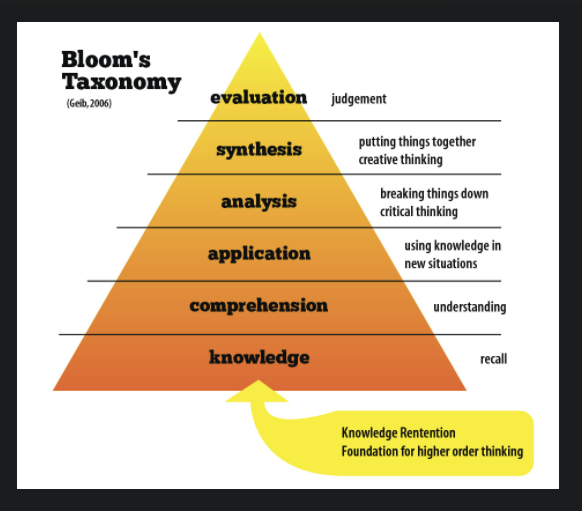
The Critical Thinking Pyramid
Though there are six levels, we will mainly focus on the base two: knowledge and comprehension.
The first layer of the pyramid, Knowledge, gets a lot of coverage in school. Through in-class lectures, homework assignments, textbook readings, field trips, and more, your child is constantly exposed to material. But in order to move through the second level of the Critical Thinking Pyramid, Comprehension, we need to ensure your child is able to remember, retain, and ultimately understand what they’ve learned. Parents can have a tremendous impact here.
Our biggest piece of advice: have conversations with your kids.
We like to call these Dinner Table Conversations. How you approach these conversations will vary by your child’s age, but the general idea is the same. Engage your child in a conversation to help them recall the information and understand what they’ve learned. While we call these Dinner Table Conversations, keep in mind that they can take place anywhere: over breakfast, in the car, or even at bedtime!
Let’s talk about some do’s and don’ts for these conversations just to get you started.
Do:
Listen
Ask questions
Get curious
Accept some awkward silences
Don’t:
Interrupt
Try show how much you know about the material
Give up
During these conversations, your role is primarily to listen and ask questions. Get curious about what they’re learning in school. Look at their handouts and ask them to teach you the material. Identify where they may have gaps in knowledge or comprehension. The first conversation may be awkward, but let the practice build and become routine. The earlier you start, the easier it will feel for both of you.
Keep in mind that you don’t have to impart the knowledge - so it’s not a problem if you don’t know or can’t remember the material. In fact, if you and your child both have a question that can’t be answered, encourage them to ask their teacher. Your job is not to show your student that you know more than them. Likewise, it’s also not a test for your child, so make sure to exercise patience if they’re struggling to recall or process information.
We’ll cover some of the more advanced levels of the pyramid in a future post. Let us know what you think, or more importantly, what you’ve learned!